
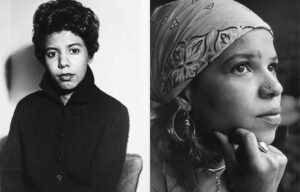
Women’s history month is a time to acknowledge and celebrate the triumph and achievement of women of all backgrounds and from all fields, especially those who left us stronger, wiser and more resilient.
In the sphere of Broadway theater, I want to lift up two amazing and history-making Black women writers: Lorraine Hansberry and Ntozake Shange.
Lorraine Hansberry, born on May 19, 1930, was the author of the first play written by a Black woman to reach the Broadway stage. A Raisin in the Sun, her most celebrated work, debuted on March 11, 1959, when Hansberry was 28 years of age. The work reflected her strong personal commitment to social justice, perhaps inspired by her father who waged a landmark housing desegregation case in her hometown of Chicago in 1937. Hansberry saw art as a tool for social change and, although her life was tragically cut short at age 32 by pancreatic cancer, her commentary on American life as an artist remains poignant and insightful.
Ntozake Shange, born on October 18, 1948, is best known for her seminal play, for colored girls who have considered suicide/when the rainbow is enuf and the birth of a new theatrical art form, the choreopoem. As a child, Shange, was among the first Black students to integrate public schools in St. Louis, MO in the Fifties and the first Black student in Trenton, NJ to desegregate the advanced curriculum classes at the local public high school in the Sixties. Harkening Hansberry’s experience, Shange’s father, a general surgeon, had to institute a lawsuit in Trenton to gain admitting privileges at one of the local hospitals.
By high school, Shange started to show an interest in poetry and writing that would ultimately steer her into a life long career as a poet, playwright, essayist, performer and novelist. Her writing was personal, emotional and, similar to Hansberry’s work, steeped in her rich knowledge and understanding of place, history and people.
Seventeen years after Hansberry’s A Raisin in the Sun, Shange’s for colored girls hit the Broadway stage on Sept. 15, 1976. Her work was the second play by a Black writer to reach such lofty heights. Shange was then just 27 years of age.
Shange’s for colored girls exploded into the culture baring topics that until then had only been spoken about in hushed tones or behind closed doors. Like Hansberry’s work, Shange’s play revealed a side of American life that was ‘hidden in plain sight’. Her revelations, poetic artistry and new art form that seamlessly featured poetry, dance and music, opened Broadway theater to new audiences, particularly Black women and the younger generation of the day. As a result, for colored girls stayed on Broadway for over two and one-half years, becoming the longest running Broadway play by a Black writer, a distinction it retains today – 50 years later.
Hansberry and Shange. They were strong, Black women who shared a commitment to social justice, a deep understanding of culture and its impact and a lifelong devotion to their craft as writers.
For Women’s History Month, let us celebrate them for their achievements and for their commitment to speaking their truth.