She wrote for all of us. For the creatives, the charismatics, the downtrodden, the cast-aside, the lovers, the dancers, the feelers, the healers. She wrote to anyone who has ever felt anything that made them feel like jumping up outta their bones.
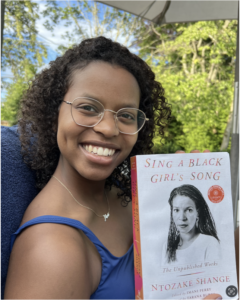
With the 50th anniversary of the first Broadway production of for colored girls who have considered suicide /when the rainbow is enuf upcoming this year, I am honored to reflect on the legacy of my aunt, Ntozake Shange.
I was decades from existence when this work of art started to take shape. In New York apartments and Berkeley basements, in dialogue with her sister, Ifa Bayeza, a talented playwright in her own right, in dance improvisation with her beloved teacher, Diane McIntyre, and most crucially, in the intricate contours of Shange’s internal mind. It was her capacity for deep intellectual thought and her unyielding willingness to look at humanity with precision that made her a powerful storyteller. With each word, phase, rhythm, image, syncopated sound–she leaves us with something to think about/see/feel.
for colored girls came to Broadway in September 1976, making it only the second play by a Black woman to reach this milestone, after Lorraine Hansberry’s A Raisin in the Sun in 1959. I was born 21 years later in the city that is the backdrop for the original play: New York, New York. In the 1970s New York was gritty, menacing and electric at the same time (or, so I hear). There is something about the friction New York creates that allows for Shange’s characters to weave together – you do simply bump into people, and into tragedy, dancing, the funniest joke you’ve ever heard and the craziest person you’ve ever seen – all in a six block radius. And yet, it is both of significance and none at all that the play is set in 1970’s New York City.
Shange wrote both of a place and beyond the confines of place. When the lady in blue tells us
“i usedta live in the world, and now I live in Harlem,” she referencing a physical universe, a place, where we are all ‘trapped’ and the metaphorical box many survivors of violence feel they live within—one in which they are not free.
The way we write and think, what we read, how we consume information and ideas becomes more homogenous and ruled by artificial intelligence every day. Shange and for colored girls thrust us back into a real, heart-beating human world. A world full of nuance, heartache, pain, joy, love and sisterhood.
for colored girls is a play, a choreopoem, a manifesto, a yearning for freedom, and an ethnography. In every character there is something we each can hold on to–can look at and feel, hold in our hands, or massage in our minds, and say I have felt that feeling before. It’s notable that even after 50 years, fcg continues to be performed on stages around the country and throughout the world. Let us remember and celebrate honest, unflinching art. Let us remember to see each other, hold each other, love each other, be the “layin on of hands” our sacred existence calls us towards.
Alex Williams-Moran